
540 watt solar panel price in pakistan
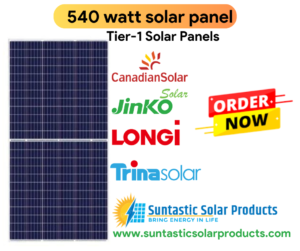
You can get 540 watt Tier-1 Solar panels in just Rs. 52,500. This is time bound price and it can be changed time to time. But in the month of June 2023 you can get 540 Watt Solar panel in just Rs.52,500. 540 watt solar panel price in pakistan is just Rs.52,500
Solar energy has emerged as a popular and sustainable alternative to traditional energy sources. As solar technology advances, different types of solar panels have been developed to meet various energy needs. In this blog post, we will explore and compare the differences between mono PERC, mono crystalline, and poly crystalline solar panels, providing you with a comprehensive understanding of each type. There are different types of solar panels but 540 watt solar panel price in pakistan is always in trend.
Comparison of Mono PERC, Mono Crystalline, and Poly Crystalline Solar Panels
Table: Comparison of Mono PERC, Mono Crystalline, and Poly Crystalline Solar Panels
| Aspects | Mono PERC Solar Panels | Mono Crystalline Solar Panels | Poly Crystalline Solar Panels |
|---|---|---|---|
| Appearance | Black or dark blue | Black or dark blue | Blue with a marbled pattern |
| Manufacturing Process | Single crystal structure with a passivation layer | Single crystal structure | Multiple crystal structure |
| Efficiency | High | High | Relatively lower |
| Space Efficiency | High | High | Relatively lower |
| Temperature Tolerance | Better | Better | Relatively lower |
| Cost | Higher | Higher | Lower |
| Durability | Long lifespan | Long lifespan | Slightly shorter lifespan |
| Performance in Low Light | Better | Better | Relatively lower |
540 watt solar panel price in pakistan
Explanation of Differences:
- Appearance: All three types of solar panels—mono PERC, mono crystalline, and poly crystalline—generally have a similar appearance, with black or dark blue cells. However, poly crystalline panels have a distinctive marbled pattern caused by the multiple crystal structure, whereas mono PERC and mono crystalline panels have a uniform appearance.
- Manufacturing Process: Mono PERC (Passivated Emitter Rear Cell) solar panels have a single crystal structure like mono crystalline panels but include a passivation layer on the rear side of the cell. This layer reduces electron recombination and enhances panel performance. Mono crystalline panels are made from a single crystal structure, typically silicon ingots, while poly crystalline panels consist of multiple silicon crystals. The manufacturing process for poly crystalline panels is simpler and more cost-effective.
- Efficiency: Mono PERC and mono crystalline panels offer higher efficiency compared to poly crystalline panels. The addition of the passivation layer in mono PERC panels improves electron collection, resulting in increased efficiency. The single crystal structure of mono PERC and mono crystalline panels allows for better electron flow, whereas poly crystalline panels have a lower efficiency due to the multiple crystal structure.
- Space Efficiency: Mono PERC, mono crystalline, and poly crystalline panels are all space-efficient. They can produce a considerable amount of electricity per square meter, with mono PERC and mono crystalline panels having a slight edge in terms of space efficiency.
- Temperature Tolerance: Mono PERC, mono crystalline, and poly crystalline panels all have better temperature tolerance compared to each other. However, mono PERC and mono crystalline panels generally exhibit better performance in high-temperature conditions, making them suitable for regions with hot climates.
- Cost: Mono PERC and mono crystalline panels are typically more expensive than poly crystalline panels. The higher cost is primarily due to the manufacturing process and the higher efficiency of mono PERC and mono crystalline panels.
- Durability: All three types of panels—mono PERC, mono crystalline, and poly crystalline—are durable and can withstand various weather conditions. However, mono PERC and mono crystalline panels usually have a longer lifespan than poly crystalline panels.
- Performance in Low Light: Mono PERC and mono crystalline panels perform better in low light conditions compared to poly crystalline panels. They can generate electricity even with limited sunlight, while poly crystalline panels have relatively lower performance in low light conditions.
Conclusion: When it comes to choosing between mono PERC, mono crystalline, and poly crystalline solar panels, it is important to consider factors such as efficiency, space efficiency, temperature tolerance, cost, durability, and performance in low light conditions. Mono PERC and mono crystalline panels offer higher efficiency and temperature tolerance, while poly crystalline panels are more cost-effective. Assess your specific energy needs and budget to make an informed decision on which type of solar panel is the best fit for your solar energy system.